


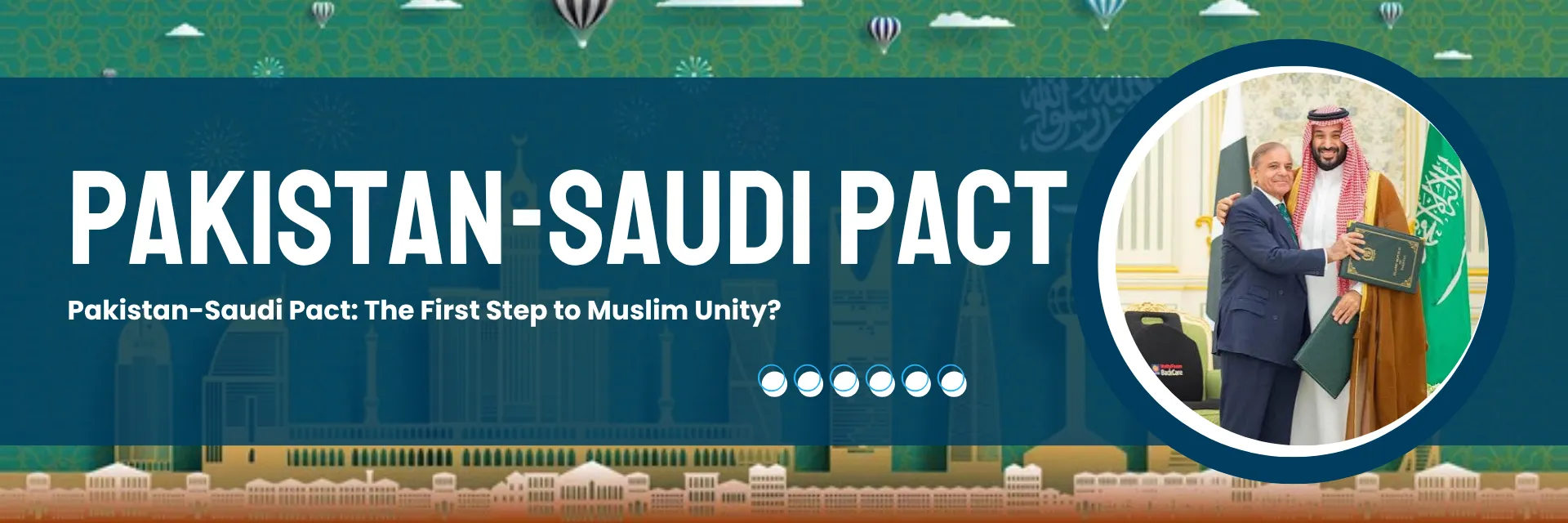
The Pakistan-Saudi defense pact signed on September 17, 2025 is a bilateral agreement under which aggression against either Pakistan or Saudi Arabia is to be treated as aggression against both. For many Muslims, the agreement raises a larger question: could closer security cooperation between Muslim-majority countries become a step toward greater unity, independence, and collective responsibility?
This article does not argue that a complete Muslim security system already exists. Rather, it explores why the Pakistan-Saudi Strategic Mutual Defense Agreement may matter, how it connects to longstanding ideas about Pakistan’s role in the Muslim world, and what would still be needed before a broader system of collective security could become real.
As a student of Source Code Academia , I came across a reflection on this agreement that made me pause. It encouraged a deeper question: where did the idea of a unified Muslim security system begin, and how far are Muslims from building one?
What is the Pakistan-Saudi defense pact?
The Pakistan-Saudi Strategic Mutual Defense Agreement was signed on September 17, 2025. Its central public commitment is clear: aggression against either country will be regarded as aggression against both.
That is a significant statement of mutual commitment. Yet the agreement should also be understood carefully. A promise of mutual defense is not, by itself, a complete regional security system. The public details available in the supplied sources do not set out the full operational structure, enforcement process, or specific response expected in every possible scenario.
Still, the agreement may signal a shift in thinking: a stronger willingness to seek security cooperation within the Muslim world rather than depending entirely on outside powers.
Why the agreement has raised bigger questions
Sometimes one agreement leads to questions that are difficult to ignore. Could Muslim-majority countries develop stronger ways of protecting one another? Could they cooperate through their different strengths rather than acting alone? And could such cooperation be built on independence, trust, and meaningful commitments rather than statements alone?
The Pakistan-Saudi defense pact does not answer all of these questions. But it gives them new urgency.
For readers who have wondered whether the Muslim world could ever stand more united, this agreement is worth examining not merely as a bilateral deal, but as a possible sign of a wider conversation about security, self-reliance, and Muslim unity.
Pakistan’s founding vision: more than borders?
The idea of Pakistan was not presented only as a question of borders and statehood. From Iqbal’s Allahabad Address to Rehmat Ali’s Now or Never , the political thought associated with Pakistan’s creation emphasized the future, security, and political standing of Muslims in the subcontinent.
In 1933, Rehmat Ali used Now or Never to argue for Pakistan as an urgent political cause, framing the question in terms of whether Muslims would “live or perish.” Nearly a century later, the circumstances are different, but the language of urgency still resonates with many Muslims who are concerned about political weakness, insecurity, and dependence on outside powers.
The argument advanced here is that Pakistan’s founding vision can be read as extending beyond the creation of a new state. It can also be read as a call for Muslim confidence, independence, and collective strength.
That interpretation deserves careful historical discussion. But from this perspective, defense cooperation between Muslim countries is not a foreign idea imposed on Pakistan. It is seen as a possible continuation of a broader aspiration for Muslim political agency.
Pakistan and the question of collective security
Pakistan is widely described as the only nuclear-armed Muslim-majority state. This gives Pakistan a position that no other Muslim-majority country holds and makes its role especially significant in discussions of Muslim-world security.
However, military strength alone cannot create a credible collective-security system. No one country can carry such a structure by itself. A functioning system would require cooperation, institutions, trust, clear commitments, and contributions from countries with different capabilities.
The question, then, is not whether Pakistan can act alone. It is whether Muslim-majority countries can build a framework in which their strengths complement one another.
What different Muslim nations could contribute
A broader security framework would depend on more than military capability. The draft identifies several forms of national strength that could matter:
- Gulf states bring energy resources and financial capacity.
- Turkey brings strategic geography, NATO experience, and a domestic defense industry.
- Iran brings experience of enduring decades of sanctions and military depth.
- Egypt brings control of the Suez Canal and a long military tradition.
- Indonesia and Malaysia bring demographic weight and diplomatic legitimacy.
- Nigeria and Bangladesh bring large populations and growing economies.
Taken together, these strengths suggest why no single country can build a wider Muslim security system alone. Geography, resources, industrial capacity, diplomacy, population, and military capability would all matter.
The central idea is simple: cooperation would be stronger when countries contribute what they can, rather than expecting one state to provide everything.
What past alliances may teach
The Muslim world has seen previous attempts at regional or international cooperation. The draft points to the Baghdad Pact, the Organisation of Islamic Cooperation, the Arab League, and the Islamic Military Alliance.
| Initiative | Draft’s central concern |
|---|---|
|
Baghdad Pact, 1955 |
It was shaped by Western patronage and influence |
|
Organisation of Islamic Cooperation, 1969–present |
It has often issued statements without enforcement mechanisms |
|
Arab League, 1945–present |
Internal rivalries and external dependence have limited unity |
|
Islamic Military Alliance, 2015 |
It has focused narrowly on counter-terrorism rather than collective defense |
The article’s argument is that these efforts lacked three things: independence, enforcement, and a stable center of gravity.
Whether that diagnosis fully explains each institution is a matter for specialists and requires sourcing. But the question remains important: what would make a future security arrangement more durable than past initiatives?
Supporters of a larger role for Pakistan may argue that its military capability, including its nuclear status, could provide part of that missing center. Yet any wider arrangement would still need broad political consent, clear rules, and credible implementation.
Why reliance on outside powers is being questioned
Many Muslims feel that international institutions and powerful states have not responded consistently to conflicts involving Muslim populations, including Palestine, Kashmir, Iraq, and Gaza. Claims about unfair justice, vetoes, double standards, or institutions “protecting their own” require case-specific evidence and careful legal and political analysis.
Even so, the perception of unequal treatment has had real influence on public debate across the Muslim world. It has encouraged renewed discussion about whether Muslim-majority countries should develop stronger ways to support one another.
From this viewpoint, the Pakistan-Saudi agreement may represent more than a routine defense deal. It may reflect a desire for greater internal cooperation at a time when trust in outside protection is contested.
Muslim unity requires more than an agreement
A bilateral pact can be meaningful without becoming a complete Muslim security system. If a broader model were ever to develop, it would need more than strong language.
It would need:
- Shared political will.
- Clear responsibilities for member states.
- Trusted mechanisms for consultation and decision-making.
- Practical arrangements for defense cooperation.
- Respect for national sovereignty and different regional interests.
- A commitment to justice, accountability, and peace.
These are not small requirements. Muslim-majority countries have different histories, alliances, strategic priorities, and internal challenges. Unity cannot be assumed simply because countries share a religious identity.
But neither should cooperation be dismissed as impossible. The Pakistan-Saudi defense pact shows that new commitments can still be made when leaders believe shared security requires them.
Now or never: a question for Muslims today
Rehmat Ali’s Now or Never was written in a very different historical moment. The comparison in this article is therefore not literal. It is a reflection on urgency.
The question facing Muslims today is whether they will remain dependent on systems shaped primarily by others, or work toward more meaningful forms of cooperation, security, and collective responsibility.
The Pakistan-Saudi defense pact is not proof that Muslim unity has been achieved. It is not a complete collective-defense structure, and it does not settle the deep political differences across the Muslim world.
It may, however, be a reminder that unity begins with practical commitments. If Muslim countries want a stronger future, they will need more than declarations. They will need institutions, trust, courage, and a shared willingness to act.
Key takeaways
- Pakistan and Saudi Arabia signed the Strategic Mutual Defense Agreement on September 17, 2025. The agreement states that aggression against either country will be regarded as aggression against both.
- The pact is a bilateral agreement, not a complete Muslim collective-security system.
- The article explores whether the agreement could become an early step toward wider Muslim security cooperation.
- Pakistan’s status as the only nuclear-armed Muslim-majority state gives it a distinctive role in these discussions.
- A broader security framework would require contributions from many Muslim-majority countries, not Pakistan alone.
- Past institutions and alliances offer lessons, but claims about why they fell short require careful historical and political sourcing.
- Muslim unity would require more than shared identity: it would require trust, institutions, enforceable commitments, and respect for different national interests.
Frequently asked questions
What is the Pakistan-Saudi defense pact?
The Pakistan-Saudi defense pact refers to the Strategic Mutual Defense Agreement signed on September 17, 2025. It states that aggression against either Pakistan or Saudi Arabia will be considered aggression against both.
Does the Pakistan-Saudi defense pact create a Muslim NATO?
No. The agreement is bilateral and does not, by itself, create a wider military alliance or a complete collective-security structure for Muslim-majority countries.
Could the pact lead to greater Muslim unity?
It could encourage discussion and future cooperation, but it does not guarantee a broader alliance. Greater unity would require political trust, shared institutions, clear commitments, and participation from other countries.
Why is Pakistan important in this debate?
Pakistan is widely described as the only nuclear-armed Muslim-majority state. The article argues that this gives Pakistan a distinctive place in discussions about wider Muslim security cooperation.
What does “Now or Never” mean in this context?
The phrase refers to Rehmat Ali’s 1933 pamphlet. In this article, it is used as a reflection on urgency: whether Muslims will pursue stronger cooperation and self-reliance or continue to depend primarily on outside powers.
Conclusion
The Pakistan-Saudi defense pact should be understood for what it is: a significant bilateral commitment, but not yet a complete Muslim security system. Its importance lies not only in its mutual-defense language, but in the wider question it brings into view.
Can Muslim-majority countries build practical, principled, and durable forms of cooperation? The answer will not come from one agreement alone. It will depend on whether states can move from statements to institutions, from aspiration to trust, and from shared concern to shared responsibility.
For Muslims thinking seriously about unity, the pact may be less an endpoint than a beginning.