


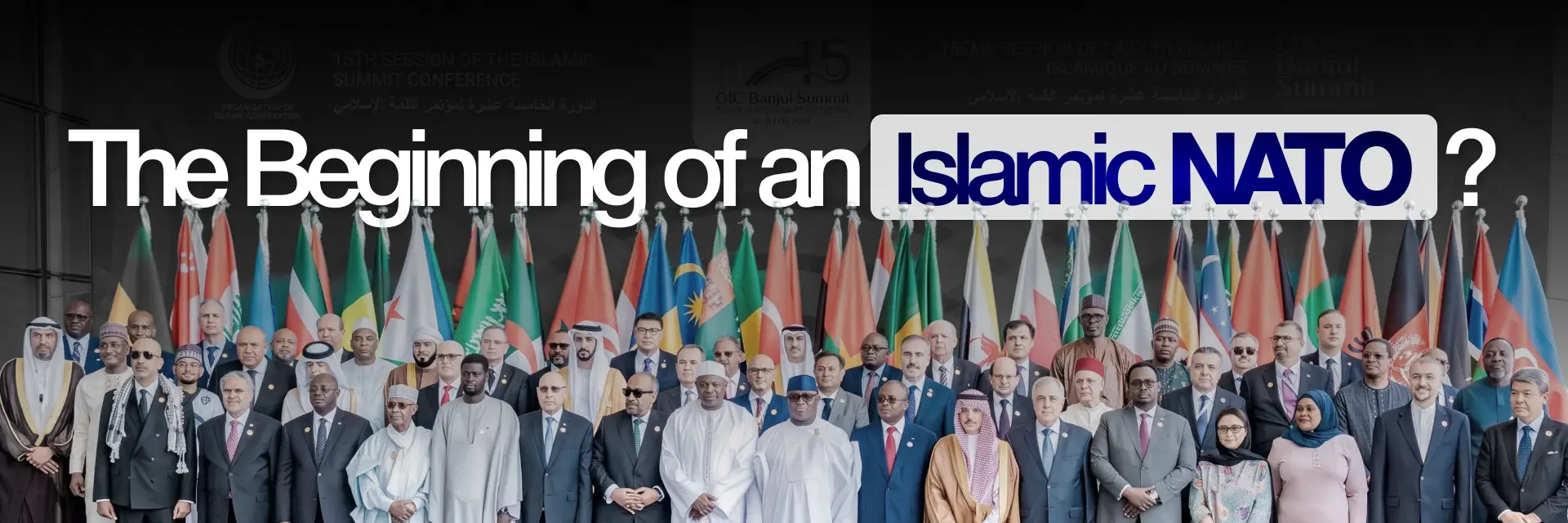
Sometimes, a development in history makes us pause and wonder whether we are witnessing the beginning of something much bigger. As a student of SourceCode Academia , I found myself reflecting on the state of the Muslim Ummah and its long-standing desire for greater unity, strength, and collective security. For years, we have asked ourselves: Can Muslim-majority nations move beyond their individual interests and learn to stand together when the security of one is threatened? Can our shared history and faith become a foundation for meaningful cooperation rather than remaining only an idea we continue to talk about?
Perhaps this is why the growing strategic relationship between Pakistan and Saudi Arabia deserves our attention. It represents more than a simple commitment to mutual safety. For many Muslims, it carries the hope of a stronger form of collective security—one in which Muslim nations can work together to protect their sovereignty, strengthen their defense capabilities, and respond to common challenges.
The idea of greater Muslim defense cooperation is not new. For decades, people have imagined what a unified framework for collective security could look like. But an idea begins to matter when it moves beyond discussion and starts taking practical form. In September 2025, Pakistan and Saudi Arabia signed the Strategic Mutual Defense Agreement (SMDA), under which aggression against one country would be considered aggression against both. The agreement marked an important step in strengthening their defense cooperation and deepening their shared security relationship.
Then, in August 2026, this vision took another step forward when Pakistan, Saudi Arabia, and Türkiye signed the Makkah Joint Defence Agreement. The agreement includes a collective-defense principle under which an armed attack against one of the three countries would be regarded as an attack against all.
Does this mean that a “Muslim NATO” already exists? No. But perhaps it gives us something more meaningful to consider: a real example of how collective defense among Muslim-majority nations could gradually take shape.
Maybe the question is no longer simply whether Muslim countries can unite. Perhaps the more important question is what kind of unity we are willing to build—and whether the cooperation we are witnessing today could become the foundation for something much greater tomorrow.
Pakistan-Saudi Partnership: Strengths, Strategy and Cooperation
To understand the significance of this partnership, it is important to look at what each country can bring to the relationship.
Pakistan brings considerable military experience, a well-established defense structure, and decades of experience in military cooperation. Its armed forces have gained extensive operational experience, while its defense institutions have developed expertise across a wide range of areas.
Saudi Arabia, on the other hand, brings enormous economic strength, strategic importance, and significant influence across the Arab and Muslim worlds. Its geographical position adds another layer of importance, as the Kingdom sits along major trade, energy, and security routes. It is also home to the two holiest sites in Islam, giving it a unique position within the Muslim world.
When these strengths come together, the potential for cooperation becomes much greater.
Pakistan can contribute military expertise, training, strategic experience, and defense cooperation. Saudi Arabia can contribute financial resources, economic strength, diplomatic influence, and important international partnerships.
Yet, the real value of this relationship would not simply come from what either country possesses on its own. Its greatest strength could come from how effectively both countries coordinate their capabilities, resources, and strategic interests.
From Bilateral Partnership to Collective Security
The most interesting question now is: what happens next?
A bilateral defense agreement can strengthen cooperation between two countries. A trilateral arrangement can take that cooperation a step further. But if several Muslim-majority countries were eventually able to coordinate within a broader security framework, the implications could be much more significant.
This is where the comparison with NATO becomes relevant—not because the current arrangements are equivalent to NATO, but because NATO provides an example of how countries can build institutions around the principle of collective defense. At its core, the idea is that an attack on one member can create responsibilities for the others.
The Pakistan-Saudi agreement brought a form of this principle into their bilateral relationship, while the later Makkah agreement extended a similar collective-defense commitment to Türkiye. These developments naturally raise a bigger question: could other Muslim countries eventually become part of a wider security framework?
In theory, countries such as Türkiye, Qatar, Indonesia, Malaysia, Egypt, and even Iran could have a role in such a discussion. In practice, however, bringing countries with different strategic interests, political priorities, and foreign policies into one defense structure would be extremely difficult. It would require far more than signing an agreement. It would demand years of diplomacy, mutual trust, compatible defense policies, institutional coordination, and a clear understanding of what collective defense should actually mean.
Even so, the discussion itself is important.
A stronger Muslim security framework would not necessarily have to begin as one large alliance. It could develop gradually through smaller and more practical forms of cooperation, such as joint military exercises, intelligence sharing, defense technology, training programs, maritime security, disaster response, and diplomatic coordination.
Perhaps that is the more realistic path forward. Instead of trying to build a massive alliance overnight, countries could begin by strengthening the areas where their interests already overlap. Over time, these smaller partnerships could create greater trust and lay the groundwork for deeper cooperation.
In that sense, the agreements being formed today may become more than isolated partnerships. They could serve as building blocks for a broader model of cooperation in the future.
The Importance of Pakistan's Military Experience
Pakistan’s role in such a vision deserves particular attention.
The country has maintained close defense ties with Saudi Arabia for decades. Pakistan has provided military training to Saudi personnel and developed long-standing defense relationships with the Kingdom. The 2025 agreement formalized and further strengthened parts of this existing cooperation.
Pakistan’s contribution, therefore, is not simply a matter of military numbers or equipment. Its experience may be just as important.
A functioning collective security arrangement depends on much more than weapons. It requires trained personnel, reliable communication systems, effective command structures, intelligence sharing, logistical planning, and the ability to coordinate during a crisis. These capabilities cannot be developed overnight. They are built gradually through experience, trust, and sustained cooperation.
This is why joint military exercises, training programs, defense research, and professional exchanges can be just as valuable as the public significance of a defense agreement. While an agreement may establish the framework for cooperation, it is the practical work carried out over time that determines how effective that cooperation can become.
Saudi Arabia's Economic and Strategic Strength
Saudi Arabia brings another important dimension to this partnership: economic strength.
Modern defense is costly. Advanced aircraft, missile-defense systems, naval capabilities, cybersecurity, intelligence infrastructure, satellite technology, and defense research all require substantial investment over many years. Saudi Arabia’s economic capacity gives it the ability to support ambitious strategic projects and long-term security initiatives.
However, financial strength alone cannot guarantee security. Resources become far more valuable when they are combined with expertise, strong institutions, advanced technology, and careful long-term planning.
This is where deeper cooperation with Pakistan, and increasingly with Türkiye, could become strategically important. Instead of viewing defense cooperation simply as the purchase of military equipment, the countries could focus on developing sustainable capabilities, sharing expertise, supporting research, and building institutions that allow them to work together more effectively.
In the long run, this approach could transform financial resources into lasting strategic capacity—creating capabilities that are built through cooperation rather than simply purchased.
Why Türkiye Changes the Picture
The emergence of Türkiye in the Makkah Joint Defence Agreement makes the discussion even more significant.
Türkiye brings its own military capabilities, growing defense industry, technological expertise, and strategic experience. This gives the three countries a potentially complementary partnership, with each contributing strengths that the others do not necessarily possess.
Pakistan brings extensive military experience and strategic depth.
Saudi Arabia contributes economic strength, geographic importance, and diplomatic influence.
Türkiye adds significant military capabilities, technological expertise, and a strong defense-industrial base.
The real challenge, however, is turning these different strengths into meaningful and practical cooperation.
The three governments have already discussed developing institutions, committees, working groups, and other mechanisms to support deeper coordination. Although these structures may receive less public attention than the agreement itself, they could ultimately prove more important.
A successful alliance cannot be built through statements and slogans alone. It requires clear institutions, regular communication, shared planning, mutual trust, and practical cooperation.
In the end, lasting security partnerships are built through systems that can work effectively—not simply through promises made on paper.
Why a Muslim NATO Alliance Would Face Major Challenges
This is where we need to be careful.
Calling the arrangement a “Muslim NATO” may capture the ambition behind the idea, but it should not be mistaken for a description of the current reality. The framework is still developing, and Pakistan’s Foreign Ministry has described the Makkah agreement as defensive and clarified that it does not formally create a new bloc.
There are also significant political and strategic differences among Muslim-majority countries. Saudi Arabia and Iran have a complicated relationship, while Türkiye has its own regional priorities. Qatar follows a distinct diplomatic path, and countries such as Indonesia and Malaysia face strategic circumstances that differ considerably from those of the Middle East.
Bringing all of these countries under a single military structure would therefore be an enormous diplomatic challenge.
But difficult does not necessarily mean impossible.
The first step may not be the creation of a unified military command. It could be something much simpler: developing habits of cooperation.
Countries that train together gradually learn each other’s strengths and limitations. Intelligence-sharing can build confidence. Joint exercises can improve coordination, while cooperation in defense technology can create deeper strategic connections.
These relationships may seem small at first, but their impact can grow over time. Eventually, cooperation can become more than a document signed by governments. It can develop into something much more valuable: trust built through experience.
From Strength to Responsibility
There is another important point that should not be overlooked.
Collective defense should not be understood simply as preparing for war. Pakistan’s Foreign Ministry has emphasized that the Makkah agreement is defensive in nature, with the broader aim of strengthening deterrence, protecting sovereignty, and supporting regional stability.
That distinction matters.
A strong defense system does not necessarily encourage conflict. In some circumstances, it can help prevent it. When countries know that aggression against one state could lead to a coordinated response from several others, the potential cost of such aggression becomes much higher. At the same time, stronger security cooperation can create more space for diplomacy because countries are able to negotiate from a position of greater confidence and security.
The purpose of collective defense, therefore, should not be confrontation for its own sake. Its greater purpose should be to protect people, preserve sovereignty, discourage aggression, and create conditions in which peaceful solutions remain possible.
Ultimately, the goal should be security, stability, sovereignty, and peace.
What Could Come Next?
If this partnership is to develop into something broader, several areas will require serious attention.
First, the countries would need stronger institutional coordination so that cooperation can continue beyond individual agreements or political leadership.
Second, reliable systems for intelligence sharing and secure communication would be essential. Without timely and trusted information, effective collective security would be difficult to achieve.
Third, regular joint military exercises could help improve coordination and interoperability. Working together in realistic situations allows military personnel to understand each other’s procedures and capabilities.
Fourth, defense technology and research could become valuable areas for long-term cooperation. Sharing expertise and investing in joint research could help participating countries develop stronger and more sustainable capabilities.
Fifth, economic cooperation should not be overlooked. Stronger economic partnerships can provide a more stable foundation for long-term security cooperation.
Finally, any expansion would require careful and patient diplomacy.
A broader Muslim defense framework could not succeed simply because its members share a common religion. Muslim-majority countries have different national interests, political systems, economic conditions, and strategic priorities. Those differences would have to be recognized rather than ignored.
The strongest common ground would therefore need to come from practical interests: sovereignty, territorial integrity, regional stability, mutual defense, economic security, and peaceful cooperation. Building around these shared interests could make deeper cooperation more realistic and sustainable.
A Vision Bigger Than One Agreement
The real significance of the Pakistan-Saudi partnership may not lie only in what these agreements achieve today, but also in what they could make possible in the years ahead.
Pakistan and Saudi Arabia have already shown that two influential Muslim-majority countries can deepen their defense cooperation. With Türkiye now part of the Makkah framework, the possibility of broader collaboration has become more tangible.
Whether this eventually develops into something resembling a wider Muslim collective-security organization remains uncertain. There are still many political, strategic, and diplomatic obstacles to overcome. But perhaps that uncertainty is exactly why this moment deserves attention.
Major institutions rarely emerge fully formed. They usually begin with relationships. Trust develops through experience, and cooperation grows through consistent effort. If the political will exists, these relationships can eventually develop into something much larger than the agreements that first brought countries together.
The idea of stronger collective security among Muslim-majority countries is not new. It has been discussed for generations. The real challenge is turning that aspiration into practical cooperation without allowing political differences, sectarian tensions, or national rivalries to undermine it.
Each country has something different to contribute. Pakistan brings military experience and strategic expertise. Saudi Arabia offers economic strength, geographic importance, and diplomatic influence. Türkiye adds significant military and technological capabilities, while other Muslim countries possess their own valuable resources, expertise, and strategic strengths.
The real question is whether these different strengths can be connected in a meaningful and sustainable way.
If they can, the Pakistan-Saudi partnership—and the wider Makkah framework—could become more than another defense agreement. It could contribute to a new model of cooperation, one based not only on shared identity but also on shared responsibility, strategic trust, knowledge, capability, and a commitment to collective security.
Perhaps that is the greater opportunity.
The goal does not necessarily have to be a “Muslim NATO.” It could be something more suited to the realities and diversity of the Muslim world: a framework through which countries can protect their sovereignty, strengthen their own capabilities, cooperate across borders, and contribute more confidently to regional and global peace.
That future is far from guaranteed. There will be disagreements, obstacles, and difficult decisions along the way.
But for the first time in a long while, the conversation is beginning to move beyond theory. The possibility of deeper cooperation is now being discussed through actual agreements, institutions, and practical partnerships.
What happens next will depend on whether these early steps can be transformed into lasting trust and meaningful cooperation.