


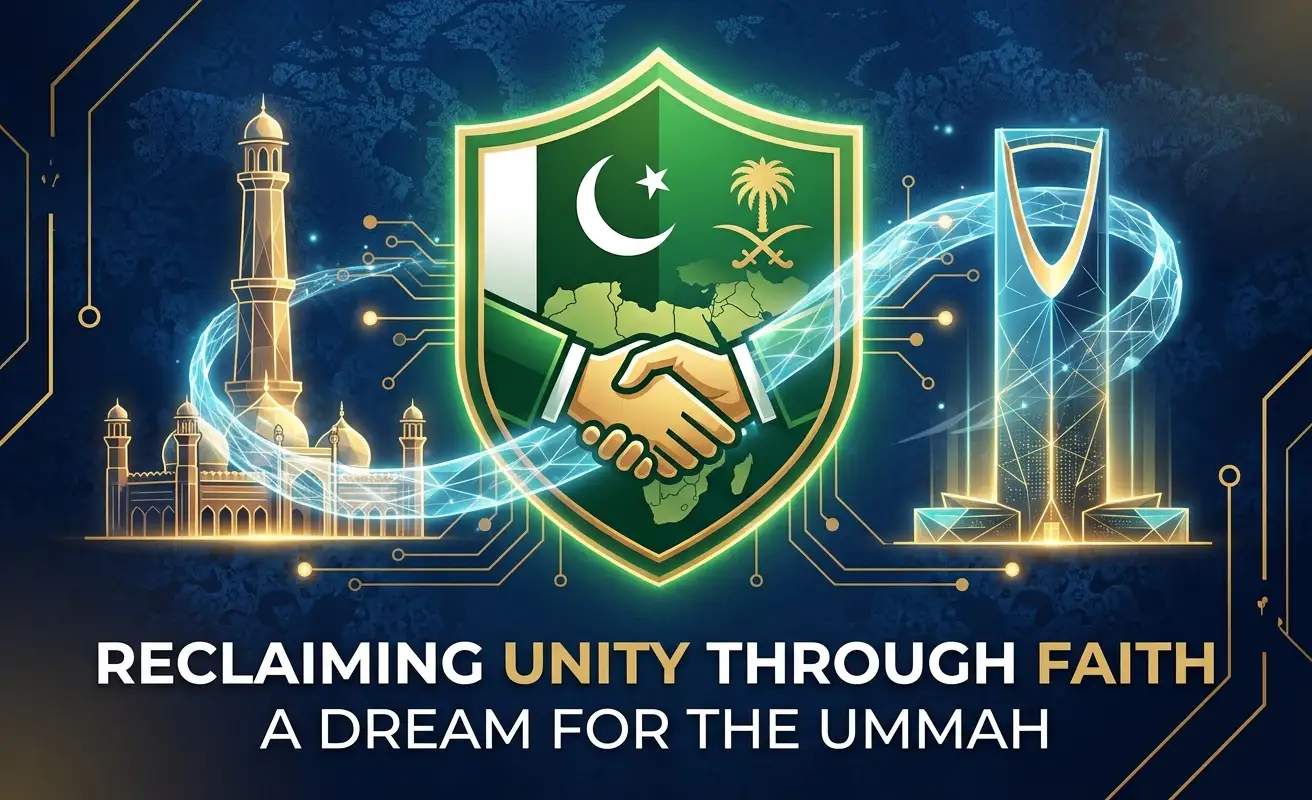
Sometimes, a single dream can leave us with questions that are difficult to answer. As a student of SourceCode Academia , I found myself reflecting deeply on the state of this Ummah today, returning again and again to a vision that would not let me rest — a vision of what we once were, and what we could still become. What happened to the Ummah that once led the world in knowledge, justice, and character? Where did that dignity go, and why does it feel so distant from us now?
We often underestimate the power of unity, and even more, we misunderstand what true unity really means. Is it found in a shared language, in nationalism, in tribe or flag? Or is it something deeper — a unity that doesn't live on paper or in treaties, but in the heart, bound only by faith in the One who created the heavens and the earth?
If you have ever looked at the state of this Ummah and felt that same ache, that same longing for something greater, this reflection is for you.
Let us turn to what we've been taught, revisit this dream together, and ask ourselves not merely how to restore our numbers, but how to restore our hearts. Perhaps that begins with a faith that binds us, a devotion that answers only to Allah, and a quiet return to the same call for justice history has echoed before, in different times and through different voices, yet always toward the same truth.
Rich in Resources, Divided by Nationality
Today, the Ummah is divided. We are large in number, yet we've turned away from action and influence. This is not a small problem — it's one worth sitting with.
So consider the situation. The question that arises is: don't we have resources? Our lands hold oil, fertile ground, and some of the largest populations on earth. And yet we still depend on other countries — for our security, our technology, even our own decisions.
Don't we all recite the same Shahadah — the same declaration of faith, word for word, no matter where we were born? And yet we still fight each other over nationality, drawing lines between ourselves that our faith never told us to draw.
One Body, One Ummah: Why We've Stopped Feeling It
Weren't we supposed to be like one body? That's not just a metaphor — it's how the Ummah was described from the very beginning: if pain is felt in one part of the body, it's felt throughout the whole. That's how the Ummah was meant to function. If one Muslim country suffers, the rest of the Ummah should feel that pain and respond — not look away simply because "it isn't happening to us." But if you look at the state of things right now, that connection is broken. Many Muslims are suffering through hardship, while the rest of the world — including Muslim countries — barely notices.
Let me remind you of the words of our Lord:
"And hold firmly together to the rope of Allah and do not be divided. Remember Allah's favor upon you when you were enemies, then He united your hearts, so you — by His grace — became brothers. And you were at the brink of a fiery pit and He saved you from it. This is how Allah makes His revelations clear to you, so that you may be rightly guided." — Surah Al-Imran, 3:103
This verse isn't just saying that unity is a good idea. It's telling us that unity was a gift — something Allah Himself granted as a favor, at a time when people were genuinely enemies. If unity was possible then, between people who truly hated one another, it's possible now too.
The Ummah I Dream Of: Brotherhood, Not Just Words
I dream of an Ummah that is truly a brotherhood — where brothers and sisters stand with one another, working for the good of the nation and every nation within it. People who feel each other's joys and each other's pain, not as a mere figure of speech, but as something real, something actually felt.
What Brotherhood Looks Like in Practice
I dream of people who feel each other's pain, and who lift one another up in times of hopelessness — people who understand that if one of us suffers, we all suffer, and if one of us rises, we all rise. This is not an abstract wish; it has a concrete shape:
- Pakistanis, Egyptians, Turks, Malaysians, and Nigerians sharing knowledge and resources instead of competing for outside approval.
- Nations trading with one another.
- Scholars, engineers, and leaders across Muslim countries collaborating instead of working in isolation.
- A shared sense that a crisis in Gaza, in Kashmir, or anywhere else in the Ummah is not someone else's problem to solve alone.
This is what brotherhood built on faith, instead of borders, must look like — it has to work in practice, not only in speech.
Every Generation Has Its Own Dream to Demand
Every generation has its own version of this call. Martin Luther King Jr. stood before a divided nation and dreamed of a day when people would be judged by their character, not their skin color. His dream was unrealistic — but that was exactly its power. It demanded that people imagine something that didn't yet exist, and act as though it already did.
The dream for the Ummah asks the same thing. It doesn't ask us to pretend that division doesn't exist — the division is real, and pretending otherwise would be dishonest. What it asks is harder: to imagine unity clearly enough to act on it, even while division is still the situation we're living in.
History shows that division is not permanent, and it is not inevitable. It is a condition — one that can be changed, the same way it was changed before.
Our Strength Lies in Unity, Not Leadership
Let me remind you plainly: our strength lies in our unity. Our guidance belongs to Allah alone — not to any single leader or nation claiming to speak for all of us.
Let us walk together, side by side, following in the footsteps of our beloved Prophet ﷺ, toward a future that is bright — not because unity is easy, but because it was shown to be possible once before, and that same door remains open.
For divided, we fall. But united under Allah, we shall rise again as a light for humanity.
References
- Surah Al-Imran, 3:103
- Surah Al-Hujurat, 49:10
- Surah Al-Anfal, 8:46
Inspired by "I Have a Dream" by Martin Luther King Jr. Author: Arooj Fatima