


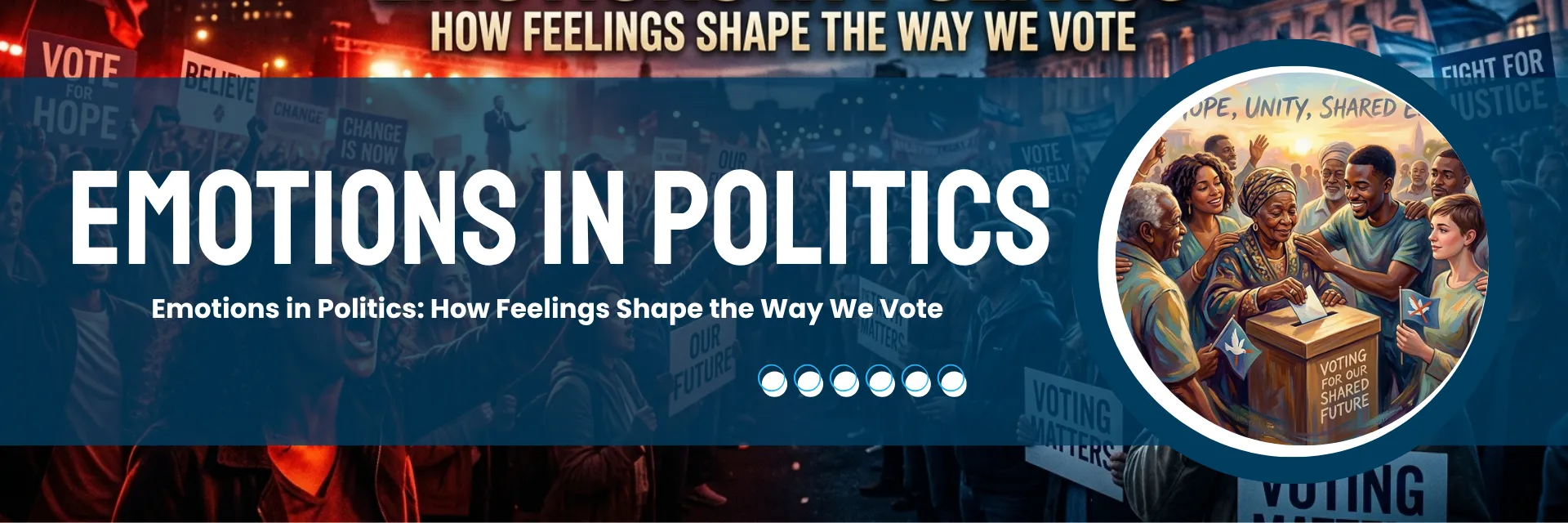
As a student at SourceCode Academia, I started asking myself a simple question: why do people vote the way they do? Politics looks like a world of strategy, statistics, and careful calculation. But the more I thought about it, the less I believed logic was what really drove the decisions that shape nations.
I think we underestimate how much emotion matters in politics. Our opinions are not built on facts and policy details alone. They are also shaped by what we fear, what we hope for, what we remember, and what we take pride in. Neuroscientist Antonio Damasio, in Descartes' Error, is often quoted as saying, "We are not thinking machines that feel; we are feeling machines that think."
Maybe you have felt your heart race during a campaign speech, or caught yourself agreeing with a slogan before reading a single line of the policy behind it. If so, this post is for you.
So let's look at how leaders win more than our votes. Hope, fear, anger, and pride have been used throughout history, sometimes to inspire justice and sometimes to control people. Once we can see how that works, we can start to tell the difference.
How Emotions Influence Political Views and Voter Decisions
It is hard to separate political judgment from human emotion. What we believe about politics is shaped by our experiences, our communities, our values, our identity, and our memories. It also depends on whether we see something as a threat or an opportunity.
Imagine two political messages that carry the same basic policy information. One is full of statistics and technical details. The other tells the story of a family affected by the issue. The facts are identical, but the second message will probably hit much harder.
That doesn't mean voters are irrational. Emotions simply affect which information we notice, remember, trust, and treat as important.
This is why political messages work on two levels: what they say, and how they make people feel.
Hope and Anger in Politics: How Emotions Mobilize Voters
Throughout history, hope and anger have moved societies to act.
Leaders like Mahatma Gandhi and Nelson Mandela became powerful symbols of change because they spoke to people's longing for freedom, dignity, and justice. Their movements were not built on technical arguments alone. They connected with what people felt and what they hoped for.
Hope gives people a sense that change is possible. It can bring them out to vote, march, protest, or take part in their own communities.
Anger works differently. When people believe they have faced injustice, discrimination, corruption, or unfair treatment, anger can push them to demand change.
But anger does not always serve justice. Where it points depends on how leaders and movements frame a problem and who they blame for it.
That is why understanding emotions in politics means looking past the feeling itself. We also have to ask what story is being told around it.
Emotional Framing in Politics: How Campaign Slogans Work
Political campaigns rarely rely on facts alone. They build stories that make voters feel a particular choice is about something bigger than a policy.
Take Donald Trump's slogan "Make America Great Again." It was more than a list of policy proposals. It spoke to national pride, nostalgia, and a wish to bring back something many people felt had been lost.
Angela Merkel's "We can do this" during the 2015 European refugee crisis worked in a similar way. The phrase became tied to Germany's response to the humanitarian situation. Her approach carried real political risks and sparked a lot of debate, but it also showed how empathy and humanitarian concern can shape political decisions.
Both examples show how political communication can turn complicated issues into stories people feel they understand.
A campaign might say:
"Here is a policy problem."
Or it might say:
"Here is what we have lost, here is what we fear, here is what we hope for, and here is how we get there."
The second version is far more likely to stick, and it can change how people read everything else they hear.
Fear in Politics: How Threats Shape Public Opinion
If hope can inspire political participation, fear can also be an extraordinarily powerful political force.
Fear focuses attention on potential threats. When people believe that their safety, family, economic security, culture, or way of life is under threat, they may become more receptive to messages promising protection.
The political response to the September 11, 2001 terrorist attacks provides an important example of how fear shaped public debate in the United States. The attacks created widespread concern about terrorism and national security. The subsequent adoption of the USA PATRIOT Act expanded government surveillance and investigative powers, while debates over civil liberties and privacy became central to discussions about the law.
The broader lesson is not that fear automatically produces one particular political outcome. Rather, moments of intense fear can change the way societies evaluate trade-offs between security, freedom, privacy, and government power.
Political rhetoric can intensify this process through simple divisions such as “us” and “them.” Such language can make complicated geopolitical situations feel easier to understand, but it can also reduce space for nuance and disagreement.
Loss Aversion in Politics: Why Voters Fear Losing More
Another idea from psychology is loss aversion.
People tend to feel the threat of losing something more strongly than the chance of gaining something of equal value. In politics, that can change how voters respond to a campaign.
The Brexit referendum is a good example. Both the Leave and Remain campaigns used arguments about what could be gained or lost. The Leave slogan "Take Back Control" focused on sovereignty and on something its supporters felt had slipped away. The Remain campaign, meanwhile, stressed the economic risks of leaving the European Union.
The campaigns framed the same decision in very different emotional terms. One side talked about winning something back, and the other warned about what could be lost.
This is why political psychology matters. The way an issue is presented can change how important it feels to people.
How Emotional Manipulation Works in Politics
Emotional persuasion is not always manipulation. Every political message carries some emotion, because political issues affect people's lives.
Manipulation becomes a problem when emotions are used on purpose to get around critical thinking, distort the facts, or make a threat seem bigger than it is.
Here are a few common techniques to watch for in political communication:
-
Fear Appeals
A message stresses a threat and says immediate action is needed to prevent disaster. -
Identity-Based Appeals
Political messages tie an issue to who someone is, such as their nationality, religion, community, class, or cultural background. -
Nostalgia
A campaign paints the past as better or safer and promises that political change can bring it back. -
Anger and Blame
A complex problem gets boiled down to one simple cause, or pinned on a particular person, group, or institution. -
Hope and Aspiration
A movement offers a compelling picture of a better future and encourages people to believe change is possible. -
Repetition
Slogans, images, phrases, and stories repeated again and again become familiar, and familiar ideas are easier to remember. -
Emotional Framing
The same policy can be sold as an opportunity, a threat, a sacrifice, or a moral duty, depending on the words used.
Recognizing these techniques does not mean rejecting emotional political communication altogether. It gives us a chance to pause and ask: What is this message asking me to feel, and what evidence supports the conclusion it wants me to reach?
Should Emotions Have a Place in Politics? A Balanced View
The answer is not simple.
Trying to take emotion out of politics would be unrealistic, because political questions are tied to human values and experience. People care about justice, security, freedom, equality, prosperity, identity, and the future of their communities, and those concerns naturally carry feeling.
At the same time, letting emotion run political judgment without a second look creates problems.
Fear can make people accept extreme measures. Anger can turn fair criticism into hostility. Nostalgia can glorify a past that was messier than the campaign slogans suggest. Hope can inspire real change, but unrealistic promises often end in disappointment.
So the goal should not be to remove emotion from political life. The harder task is to build emotional awareness alongside political literacy.
Political Literacy: Questions to Ask Before You Believe
Political literacy means understanding political systems, policies, institutions, evidence, and competing arguments. Emotional awareness adds something more: understanding how political messages affect our own reactions.
Before we accept a powerful political message, we can ask ourselves a few questions:
- What emotion is this message trying to create?
- Is it appealing to fear, anger, hope, pride, or empathy?
- What evidence supports the claim?
- Is important context being left out?
- Am I reacting to the facts, or mostly to the way the issue has been framed?
- What would I think if the same information were presented in different words?
- Are there other explanations for the problem being discussed?
These questions don't tell anyone which political position to take. They simply help us make decisions with our eyes open.
Aristotle on Emotions: Why Politics Needs Balance
Aristotle understood that emotions are not good or bad in themselves. What matters is how, when, and why we feel them.
In the Nicomachean Ethics, he wrote that feeling "the right emotion, at the right time, toward the right objects, toward the right people, for the right reason, and in the right way" is not easy.
That idea still fits modern politics.
A society without political emotion is hard to imagine. Compassion can drive humanitarian action. Anger can draw attention to injustice. Hope can push people to work for reform. Fear can warn societies about real dangers.
But every one of these emotions can also be misused.
The real challenge is not choosing between emotion and reason. It is learning how the two work together.
Final Thoughts: Why Emotional Awareness Matters in Politics
The emotional side of politics shows us something important about democratic societies: people don't make political decisions like detached calculators. We read political events through our experiences, values, identities, memories, hopes, and fears.
Political leaders know this, which is why emotional storytelling has always been part of political communication.
But the responsibility doesn't rest with politicians alone. Citizens have a role to play too.
When a political message makes us extremely angry, afraid, proud, or hopeful, that reaction can be a reason to pause instead of act right away. We can ask what the message is really saying, what evidence supports it, and what might be missing. We can also ask whether our emotional response is helping us understand the issue, or just making us easier to persuade.
Emotions are not the enemy of good political judgment. They are part of being human. But emotional awareness, together with political literacy, helps us notice when our feelings are helping us engage with political questions, and when someone may be using those feelings to steer us.
So the question is not whether emotions belong in politics. They already do.
The better question is whether we can understand our emotions well enough to stay thoughtful and informed when we make political decisions.