

Are You sure you want to delete Member from list ?


The Battle of the Minds: How Emotional Intelligence and IQ Shape Success in Life and Work
What is IQ and How is it Measured?
The Intelligence Quotient (IQ) represents an individual’s cognitive capacity relative to a population norm. Traditionally, IQ is assessed through standardized tests that measure logical reasoning, verbal comprehension, spatial ability, and mathematical problem-solving. The earliest measure—the Binet–Simon scale—was introduced in 1905 to identify children needing academic assistance. Later developments, such as the Wechsler Adult Intelligence Scale (WAIS), refined this approach by evaluating multiple domains of intelligence (Wechsler, 2008).
IQ testing provides a numerical representation of cognitive performance, where the average score is standardized at 100 with a standard deviation of 15. It reflects abilities like memory, reasoning, and analytical speed, which contribute significantly to academic and technical achievement.
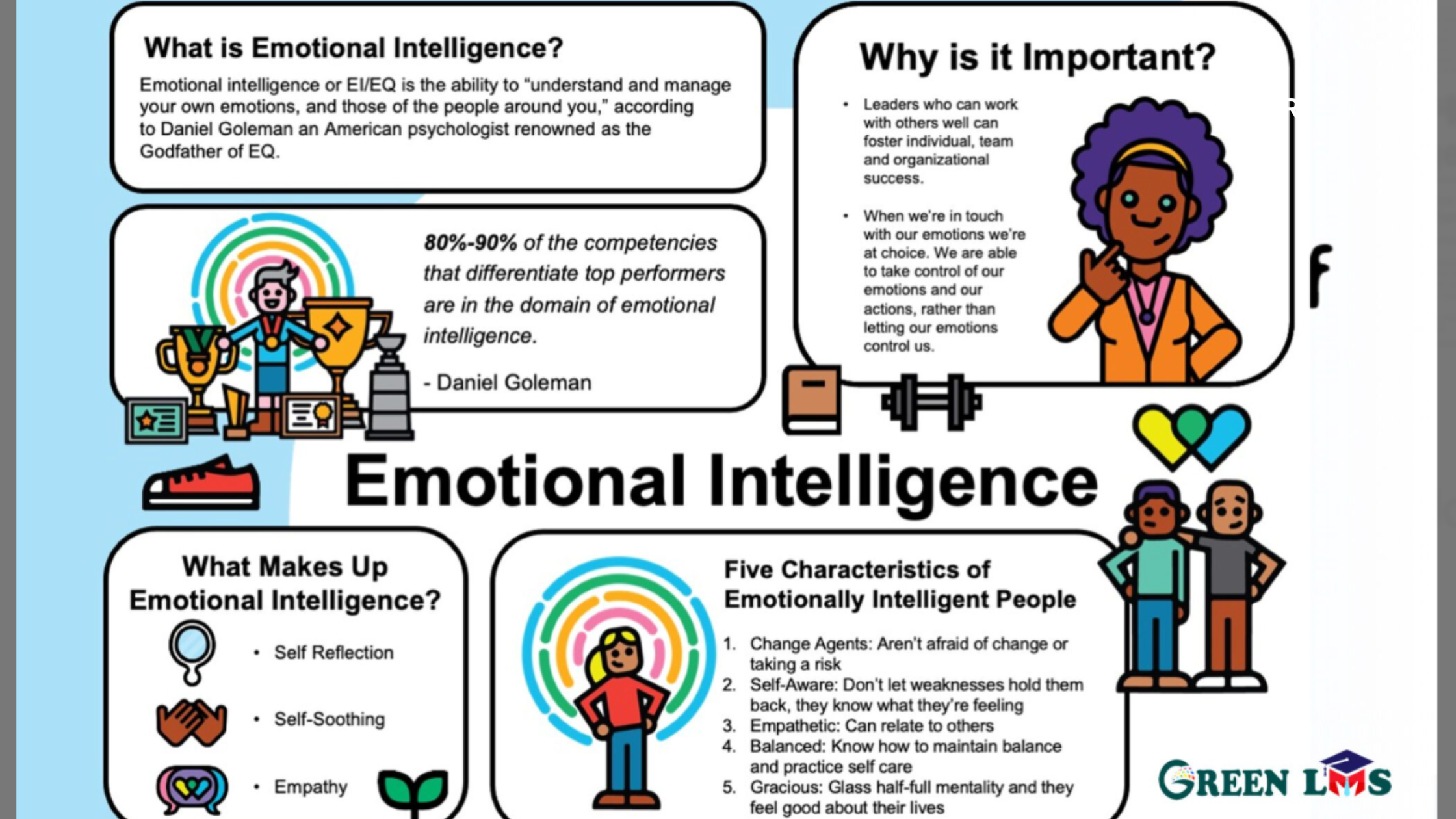
Emotional Intelligence (EI), popularized by Daniel Goleman (1995), is defined as the ability to perceive, understand, regulate, and utilize emotions effectively. It encompasses four primary domains: self-awareness, self-regulation, social awareness, and relationship management. These domains work collectively to shape interpersonal effectiveness and emotional resilience.
Neuroscientific research demonstrates that emotional processing occurs primarily in the limbic system—especially the amygdala—while rational thought is governed by the prefrontal cortex. The interaction between these systems determines how emotions influence decision-making, stress regulation, and communication (LeDoux, 1998).
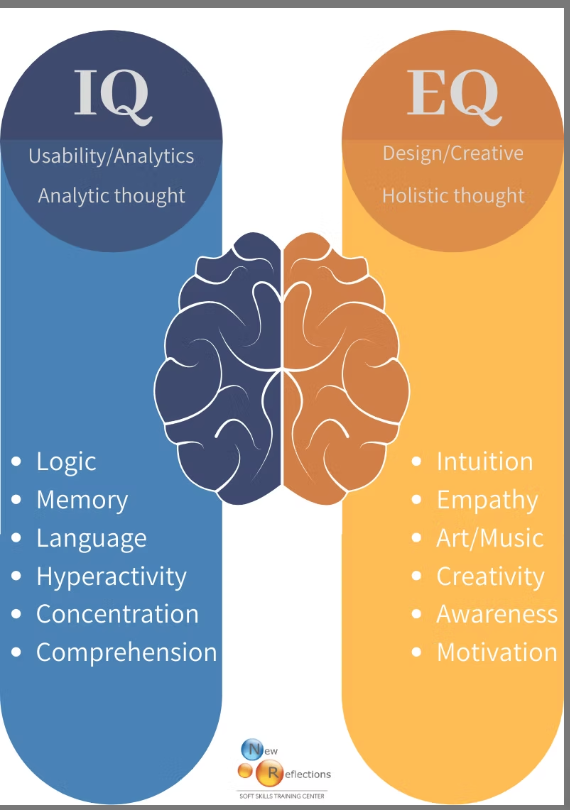
IQ primarily concerns analytical and problem-solving capabilities, whereas EI focuses on interpersonal understanding and emotional adaptability. IQ emphasizes processing speed, while EI emphasizes processing depth—the capacity to interpret subtle emotional signals and contextual nuances. Unlike IQ, which tends to remain stable after early adulthood, emotional intelligence is considered developable through deliberate training and feedback (Mayer, Salovey, & Caruso, 2008).
During the 20th century, IQ testing became central to educational and occupational assessment. Schools employed IQ-based placement systems, while organizations used cognitive tests to identify high-potential employees (Neisser et al., 1996). However, overreliance on IQ also produced social stratification, reinforcing the notion of intellectual hierarchies and neglecting other human capabilities such as creativity and empathy.
The 1990s marked a paradigm shift as researchers and practitioners began emphasizing emotional competencies. The publication of Goleman’s Emotional Intelligence: Why It Can Matter More Than IQ (1995) catalyzed widespread interest across business, education, and psychology. Emotional intelligence became recognized as essential for effective leadership, conflict management, and organizational change (Boyatzis, Goleman, & Rhee, 2000).
Recent longitudinal studies suggest that while IQ predicts academic success, emotional intelligence better forecasts career success, relationship quality, and psychological well-being (Joseph, Jin, Newman, & O’Boyle, 2015). Neuroimaging research further reveals that emotional and cognitive systems are deeply intertwined, indicating that effective decision-making relies on both rational analysis and emotional insight (Pessoa, 2008).
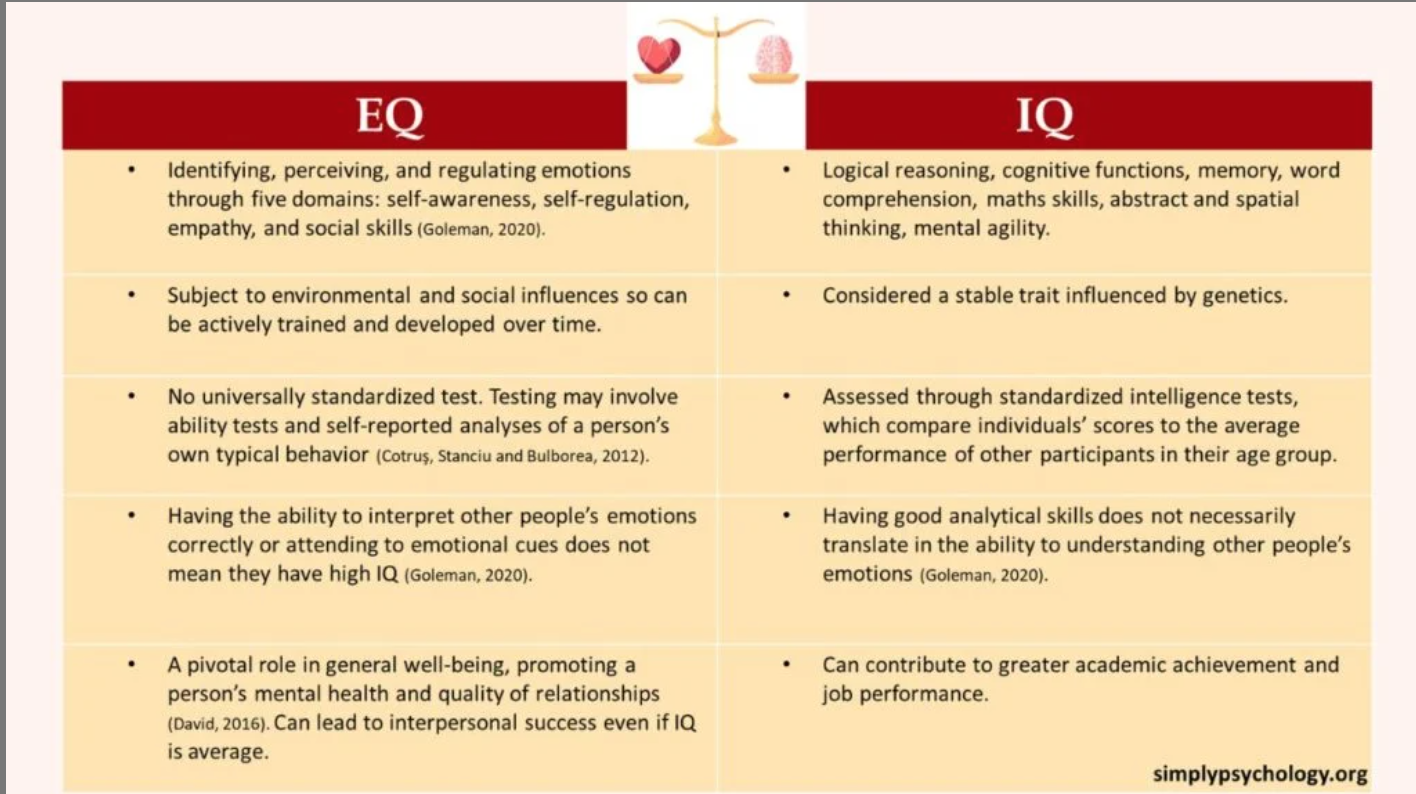
While IQ remains a strong predictor of academic achievement, emotional intelligence influences how effectively knowledge is applied, especially in collaborative settings.
Example:
A group of engineering students is working on a complex project. One member notices tensions rising due to disagreements about design decisions. A student with high EI recognizes the frustration (social awareness) and suggests a short meeting to hear everyone’s concerns (relationship management). By mediating the discussion calmly and acknowledging emotions (self-regulation), the group resolves the conflict and meets the project deadline.
Emotional intelligence is critical for leaders in motivating teams, managing conflicts, and guiding change.
Example:
An emotionally intelligent manager notices that a high-performing employee is increasingly withdrawn due to interpersonal tension in the team. By initiating a one-on-one discussion (self-awareness and empathy) and offering support and constructive feedback (self-regulation and relationship management), the manager restores engagement, resolves the conflict, and enhances overall team productivity.
Contrast:
A leader with high IQ but low EI might ignore these emotional cues, resulting in unresolved conflict, decreased morale, and lower team performance.
High emotional intelligence improves communication, empathy, and resilience in personal interactions.
Example:
During a family disagreement, an individual with high EI listens actively to understand each person’s perspective (social awareness), controls emotional reactions (self-regulation), and facilitates a compromise that satisfies everyone (relationship management). This approach strengthens trust and long-term relationships.
Contrast:
Conversely, low EI can exacerbate conflicts—misunderstandings escalate, and relationships suffer, even if the individual is otherwise intelligent.
In professional environments, the ability to navigate emotions determines collaboration and long-term career growth.
Example:
A team faces a critical deadline. An emotionally intelligent employee detects rising stress levels and proactively organizes a brief team check-in. By acknowledging pressures, offering solutions, and fostering mutual support, the team completes the project efficiently. Employees trust leaders and colleagues who demonstrate such emotional competence.
Contrast:
Without EI, technical expertise alone cannot prevent miscommunication, low morale, or project delays—common hurdles to achieving organizational goals.
Employers increasingly seek a balance between cognitive ability and emotional intelligence. While technical positions prioritize IQ-related competencies, service and management roles emphasize empathy, communication, and adaptability.
Performance evaluations often weigh both technical competence and interpersonal skills. As professionals move into leadership roles, emotional intelligence becomes a decisive factor in career advancement and long-term sustainability (Goleman, Boyatzis, & McKee, 2013).
In technical fields, high IQ correlates with specialized expertise and salary premiums. However, executive compensation and leadership success often depend on the ability to manage relationships, navigate complexity, and build trust—core outcomes of emotional intelligence (Chamorro-Premuzic, 2016).
Boyatzis, R. E., Goleman, D., & Rhee, K. (2000). Clustering competence in emotional intelligence: Insights from the Emotional Competence Inventory (ECI). In R. Bar-On & J. D. A. Parker (Eds.), Handbook of Emotional Intelligence (pp. 343–362). Jossey-Bass.
Brackett, M. A., Rivers, S. E., & Salovey, P. (2011). Emotional intelligence: Implications for personal, social, academic, and workplace success. Social and Personality Psychology Compass, 5(1), 88–103.
Chamorro-Premuzic, T. (2016). The talent delusion: Why data, not intuition, is the key to unlocking human potential. Piatkus.
Cherniss, C. (2010). Emotional intelligence: Toward clarification of a concept. Industrial and Organizational Psychology, 3(2), 110–126.
Goleman, D. (1995). Emotional Intelligence: Why It Can Matter More Than IQ. Bantam Books.
Goleman, D., Boyatzis, R., & McKee, A. (2013). Primal Leadership: Unleashing the Power of Emotional Intelligence. Harvard Business Review Press.
Grant, A. M., Curtayne, L., & Burton, G. (2009). Executive coaching enhances goal attainment, resilience, and workplace well-being: A randomized controlled study. The Journal of Positive Psychology, 4(5), 396–407.
Jaeggi, S. M., Buschkuehl, M., Jonides, J., & Perrig, W. J. (2008). Improving fluid intelligence with training on working memory. Proceedings of the National Academy of Sciences, 105(19), 6829–6833.
LeDoux, J. (1998). The Emotional Brain: The Mysterious Underpinnings of Emotional Life. Simon & Schuster.
Mayer, J. D., Salovey, P., & Caruso, D. R. (2008). Emotional intelligence: New ability or eclectic traits? American Psychologist, 63(6), 503–517.
Neisser, U., Boodoo, G., Bouchard, T. J., Jr., Boykin, A. W., Brody, N., Ceci, S. J., ... & Urbina, S. (1996). Intelligence: Knowns and unknowns. American Psychologist, 51(2), 77–101.
Pessoa, L. (2008). On the relationship between emotion and cognition. Nature Reviews Neuroscience, 9(2), 148–158.
Wechsler, D. (2008). WAIS–IV: Wechsler Adult Intelligence Scale–Fourth Edition. Pearson.