

Are You sure you want to delete Member from list ?


What is dopamine?
Imagine your brain has a tiny mail carrier who brings stickers whenever you do something useful. That mail carrier is called dopamine. Dopamine does not make joy all by itself. It mostly tells your brain, “Hey, that thing was important—remember it and go after it next time!” Scientists call this a reward-prediction signal—your brain compares what it expected with what actually happened and then learns to chase good clues (Schultz, 1997; Berridge & Robinson, 1998, 2016).
So, when a phone pings, a game sparkles, or sugar tastes sweet, dopamine puts a bright sticker on that moment and says, “Chase this cue again.” Joy (the warm, peaceful “mmm”) leans more on other systems, like opioids and endocannabinoids. That’s why people can want very hard without actually liking the thing anymore.
Why “dopamine fasting” is not the full answer
“Dopamine fasting” means we stop very stimulating things for a while: social media, junk food, bingey videos, etc. This can reset attention. But if you suddenly stop everything without a plan, your brain often pushes back. That pushback is called withdrawal. It can feel like:
This is normal biology—your learning system is re-balancing (Koob & Le Moal, 2001; 2008). Modern life makes it harder: work wants you focused 9–5, family needs you 6–10. No one can be 100% “on” all day. So, fasting can help, but fasting alone is not a lifestyle. We also need root-cause work (old hurts, beliefs, identity) and a daily rhythm that honours body and soul.
“The servants of the Most Merciful are those who restrain anger and forgive.” (Qur’an 3:134)
“The strong one is the person who controls himself at the time of anger.” (Bukhārī; Muslim)
“The most beloved deeds to Allah are those done regularly, even if small.” (Bukhārī; Muslim)
A simple story: the red bell and the blue pause
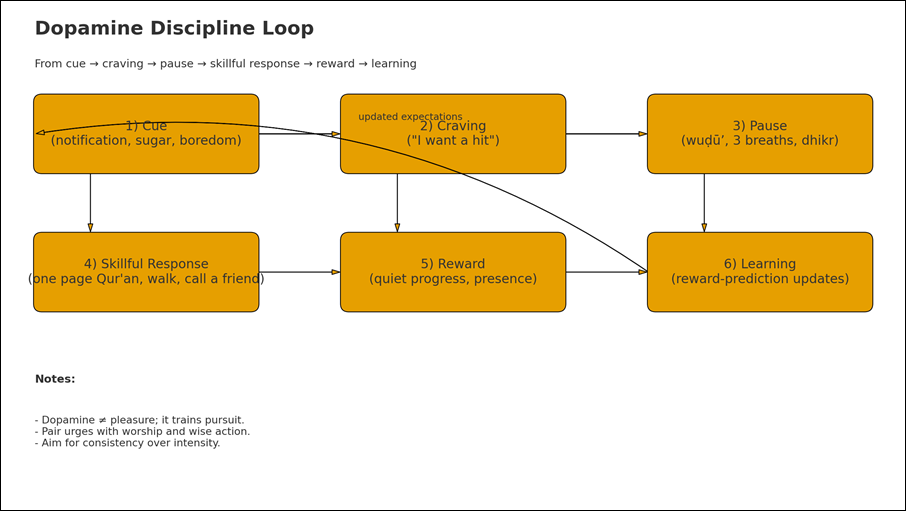
Sami has a box with a red bell. Whenever he hears it, he wants a cookie. One day, his dad adds a blue pause button next to the bell. Now, when the bell rings, Sami presses the blue button first: he drinks water, takes three calm breaths, says “Bismillah,” and then chooses—cookie later or play now? After a week, Sami still likes cookies, but he no longer needs them every time the bell rings.
That blue button is what we will build for you.
What withdrawal really looks like (so you can plan, not panic)
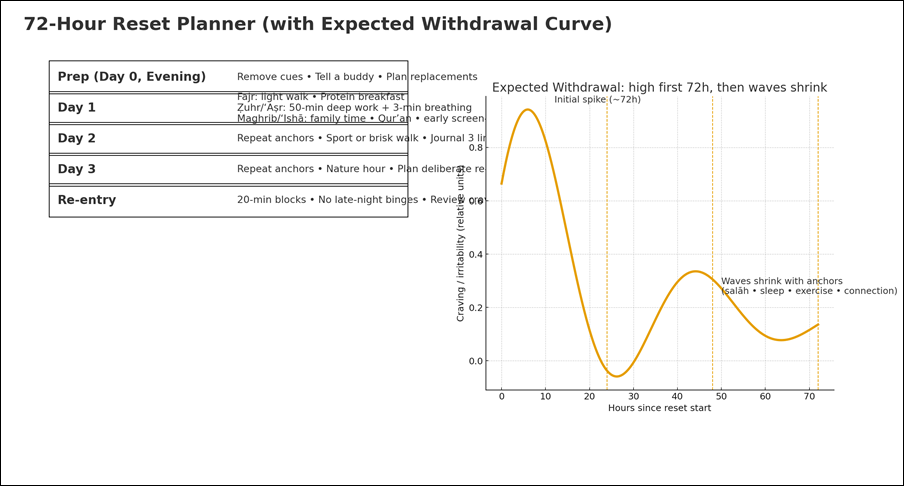
For highly rewarding habits (phones, sugar, gaming, outrage-scrolling), people often see:
Evening self-check (0–10): craving, mood, energy, sleep, focus. Do this for 14 days. If numbers jump, you’re not failing—your nervous system is adjusting.
The middle way: not cold-turkey chaos, not endless slow fade
Think of a bridge with three planks:
1) Punctuated Resets (48–72 hours, with a safety net)
Pick only one or two high-dopamine traps (e.g., doom-scrolling + late-night sugar). Schedule Fri Maghrib → Mon Fajr off for those items.
Before the reset
During the reset
After the reset
2) Steady Rebuild (a day that serves your brain and your Deen)
Let salāh be your four islands of calm.
Use Gross’s emotion-regulation steps: change the situation (leave the room), shift attention (dhikr), re-think the urge (“my brain expects a hit; I can wait”), then respond wisely (small action) (Gross, 2015).
3) Root-Cause Repair (where lasting calm lives)
Two short, real-life style stories
Hamza (all-or-nothing → strong middle way)
Hamza quit sugar, social media, and gaming in one day. On Day 3, he snapped at family, then binged and felt ashamed. We mapped his withdrawal curve, set 72-hour planned resets, and gave him a 5-minute blue-pause (wuḍūʼ + walk + dhikr). Four weeks later, evening binges fell from daily to once in twelve days; sleep and mood lifted.
Aisha (balanced rebuild while working full-time)
Aisha kept her job routine but cut back on outrage-scrolling to only weekends. She anchored breaks to prayer, lifted weights three times a week, and began EMDR therapy for childhood criticism that fueled her perfectionism. At six weeks, she said, “There’s less noise in my head,” and finished an online course she had delayed for a year.
PLAN:
Build the Blue-Pause Button (teach it like a game)
Design Evenings That Calm the Brain
Track Three Numbers Nightly (0–10)
Craving, Mood, Sleep. Review on Friday. If anything dips for a week, lighten the load: earlier bedtime, simpler meals, and a smaller to-do list.
Choose One Weekend Reset Each Month
When to call for extra help
If withdrawal feelings are scary, harm relationships, or block work for more than two weeks, speak to a therapist and a trusted imam. Islam pairs skill with trust: “Tie your camel, then trust in Allah.” (Tirmidhī)
Gentle truths to keep nearby
A compact cheat-sheet
References (select)
Qur’an & Hadith
Educational guidance, not medical care. If you suspect clinical addiction or severe withdrawal, seek professional support.