

Are You sure you want to delete Member from list ?


Daniel Goleman, born on March 7, 1946, is an American psychologist, author, and former science journalist who spent over a decade writing about brain and behavioral sciences for The New York Times. He gained global recognition with his 1995 book Emotional Intelligence, which remained on the bestseller list for approximately 18 months and has since been translated into dozens of languages.
In this widely influential work, Goleman put forward a new perspective on human performance. He argued that success cannot be explained by cognitive ability (IQ) alone, highlighting instead the significant role of emotional intelligence in predicting professional achievement. Traditional performance measures, in his view, overemphasized academic intelligence while neglecting emotional and social competencies.
Emotional intelligence is defined as the ability to identify, assess, and manage one’s own emotions, as well as to understand and respond appropriately to the emotions of others. While it does not directly determine outcomes in academic tasks such as exams or written assignments, it strongly influences how people manage relationships, regulate behavior, and make decisions. Individuals with higher emotional intelligence tend to collaborate more effectively, solve problems efficiently, and adapt creatively within organizations.
To make the concept more applicable, Goleman introduced a performance-based model aimed at evaluating and developing emotional intelligence in the workplace. His framework outlines five key components that together shape EQ.
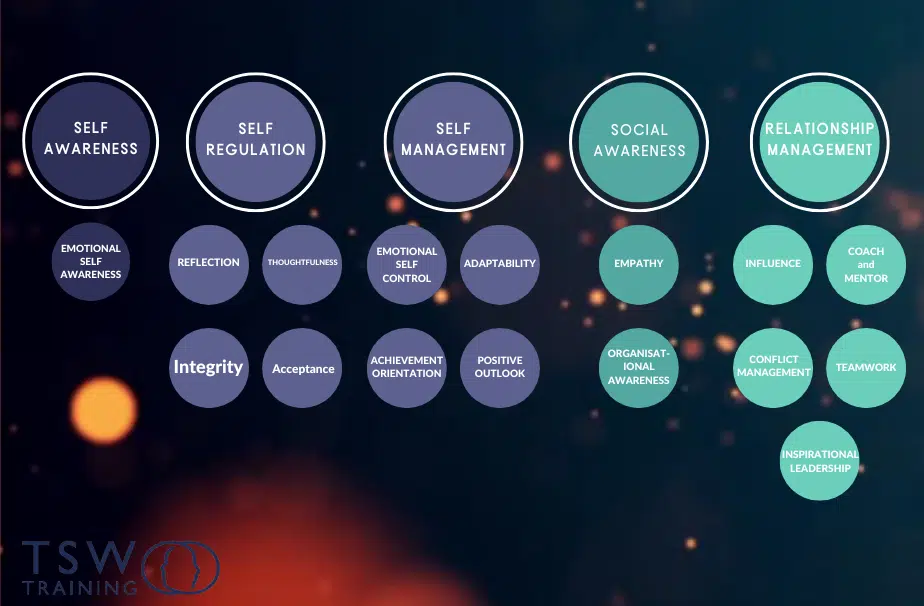
The model consists of five components, stated below:
Goleman argues that individuals who develop these five areas are more likely to achieve success in their careers and contribute positively to their organizations. Importantly, he highlights that emotional intelligence is not an innate trait fixed at birth; rather, it can be cultivated and strengthened over time. These components also reinforce one another, meaning improvements in one area can enhance overall emotional competence.
In his later work, particularly around 2000, Goleman reorganized his model into four broader domains: self-awareness, self-management, social awareness, and relationship management. Each of these domains includes specific competencies that explain how emotional intelligence functions in real-world contexts.
Overall, Goleman promotes a balanced view of human capability, arguing that both IQ and EQ are essential for achieving personal effectiveness, strong leadership, and long-term success.