

Are You sure you want to delete Member from list ?


“I think everybody should get rich and famous and do everything they ever dreamed of so they can see that it's not the answer.”
Jim Carrey
Why do people sometimes feel empty even when life seems full? What lies beneath the moments of success or pain that shape our inner world? This article explores these questions by examining the experience of inner emptiness and the search for meaning behind it. To understand this more clearly, two real-life reflections are presented: Maheen’s story, which shows emptiness within achievement, and Sara’s story, which reveals meaning through loss.
Maheen’s story illustrates how emptiness can quietly appear even at the peak of success.
She stood in the large, bright hall of a famous German university. The lights, the smiling faces, and an air thick with excitement filled her with profound happiness. This was the moment she had dreamed of for years. Yet, as time passed, that intense joy faded into the daily grind of routines, classes, and workloads. Everything began to feel ordinary; her once vivid emotions slowly dimmed. Inside, Maheen began to sense a quiet emptiness she could not explain, a silent struggle that no achievement seemed to fill. Why can we not sustain feelings of joy or sorrow? We achieve and acquire, checking items off a long list of desires. One is fulfilled, and another quickly takes its place. Yet, the inner emptiness remains. What is it that stays hungry even when life seems full?
This endless chase, where joy quickly fades and new desires arise, is what psychologists call the hedonic treadmill. It describes a cycle of constant movement without a sense of arrival. No matter what a person achieves, their happiness tends to return to a baseline level. As the new becomes familiar, the pursuit begins again.
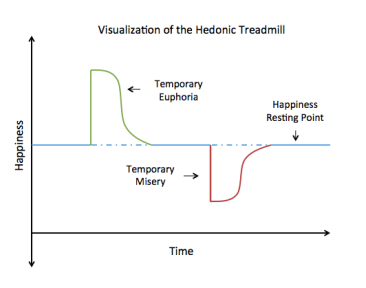
Over time, this constant search for happiness can create a deeper sense of emptiness, known as an emotional void. It is a state in which a person feels hollow or finds life meaningless. Psychologists such as Viktor Frankl, Carl Jung, and M. Scott Peck describe it as a form of existential emptiness that appears when life feels disconnected from purpose or deeper values. Everyone experiences it differently; some describe it as inner silence, others as purposelessness, and still others feel as though the life in their heart or mind has faded away.If this emptiness continues unchecked, it may lead to chronic psychological issues or mental health disorders. Yet my discussion here does not explore this in depth. At a surface level, it may simply reflect a phase when life feels directionless, and a quiet inner voice urges a person to search for meaning. Most of us try to fill this emptiness with luxuries, external achievements, or endless scrolling through social media, often without understanding why, hoping it will make the void disappear. Yet these attempts often feed only the nafs, the self driven by desire, while the ruh, the soul, remains hungry.
After understanding this idea through Maheen’s quiet struggle, Sara’s story offers a deeper example where emptiness reveals itself through pain and loss. This inner emptiness often remains invisible until life forces a confrontation with it, as it did for Sara. She had been taken to the hospital for almost the tenth time after suffering another panic attack. Ever since her mother’s death, the woman who had been the center of her world, Sara had felt as if a part of her had died too. All the medical reports came out normal, yet nothing felt normal inside her. Lying on the hospital bed, she kept wondering, “What am I doing with my life? Why do I go through this pain that feels like dying but never actually die?” In that still moment, a thought crossed her mind for the first time. Perhaps Allah had sent her into this world for a reason. She realized she had never truly tried to open the Qur’an and understand it. As that thought settled in, a tear slipped down her cheek. That day, she made a silent promise to herself to search for the real purpose of her life. After this realization, Sara’s connection with faith became her main source of strength. Further reflection showed three important changes. She started to see her pain as a meaningful test, not a punishment. Through deeper Qur’anic study and learning courses, she developed a clearer sense of purpose and inner calm. Over time, her anxiety became lighter, showing greater emotional balance and trust in Allah.
Witnessing Sara’s struggle made me reflect on my own faith. I often wonder what truly differentiates me as a Muslim from a Christian or a Buddhist. They, too, seek peace and purpose. We all perform rituals, pray, and strive for inner calm. Sometimes, Christians and Buddhists even appear more disciplined and devoted in their practice than many Muslims. So, what is the real difference? My answer is not final, but a reflection shaped by continuous learning.
In Islam, peace is not the prize we chase, but the consequence of surrendering to Allah. While other paths strive to find stillness or enlightenment, a Muslim begins from a place of submission, knowing true peace flows only from obedience to the Creator. Life itself is a sacred trust, an Amanah, and our existence has a divine purpose: to recognize Allah, serve Him, and act as His vicegerents on earth by upholding justice and moral values. The Qur’an states, “I did not create jinn and humans except to worship Me” (Surah Adh-Dhariyat, 56). This worship transcends rituals; it is a continuous awareness of Allah in our thoughts, choices, and service.
Thus, the Qur’an serves as a complete guide, offering divine solutions, wisdom, and practical instructions for every aspect of life.
A Buddhist may meditate to escape suffering; a Christian may pray for salvation. A Muslim, however, views both joy and pain as opportunities to draw nearer to Allah. Our purpose cannot end with our own peace or salvation. We do not exist merely to escape hardship; we exist to live in alignment with divine truth and to establish Allah’s din on earth. This awareness gives our faith its moral direction. We are not meant to be self centered seekers of Jannah, but bearers of guidance and mercy for others. Our journey toward Paradise includes helping other hearts find their way through compassion, justice, and example. Even when life seems full of achievements and pleasures, it is this alignment with a divine purpose that truly nourishes the soul.