

Are You sure you want to delete Member from list ?


قَالَ ﷺ: **لَوْ يَعْلَمُ المُؤْمِنُ مَا عِنْدَ اللَّهِ مِنَ العُقُوبَةِ مَا طَمِعَ بِجَنَّتِهِ أَحَدٌ، وَلَوْ يَعْلَمُ الكافِرُ مَا عِندَ اللَّهِ مِنَ الرَّحْمَةِ مَا قَنَطَ مِنْ جَنَّتِهِ أَحَدٌ. (رواہ مسلم)
"If a believer knew the punishment of Allah, none would have hoped for His Paradise. And if a disbeliever knew the mercy of Allah, none would have despaired of His Paradise." (Sahih Muslim)
This profound hadith does not just outline a spiritual state; it provides the master key to optimal brain development in our youth. Modern neuroscience has discovered what the Quran and Sunnah have always taught: a balanced heart cultivates a resilient, intelligent, and morally grounded mind.
Here I am trying to blend the timeless wisdom of the Seerah with contemporary brain science to offer a practical guide for nurturing the whole youth—mentally, emotionally, and morally.
Neuroscientists have identified a network in the brain called the "Hope Circuit," which is responsible for goal setting, motivation, and resilience. This track mirrors the Islamic concepts of Raja' (Hope).
Here how this brain network supports a believer's journey:
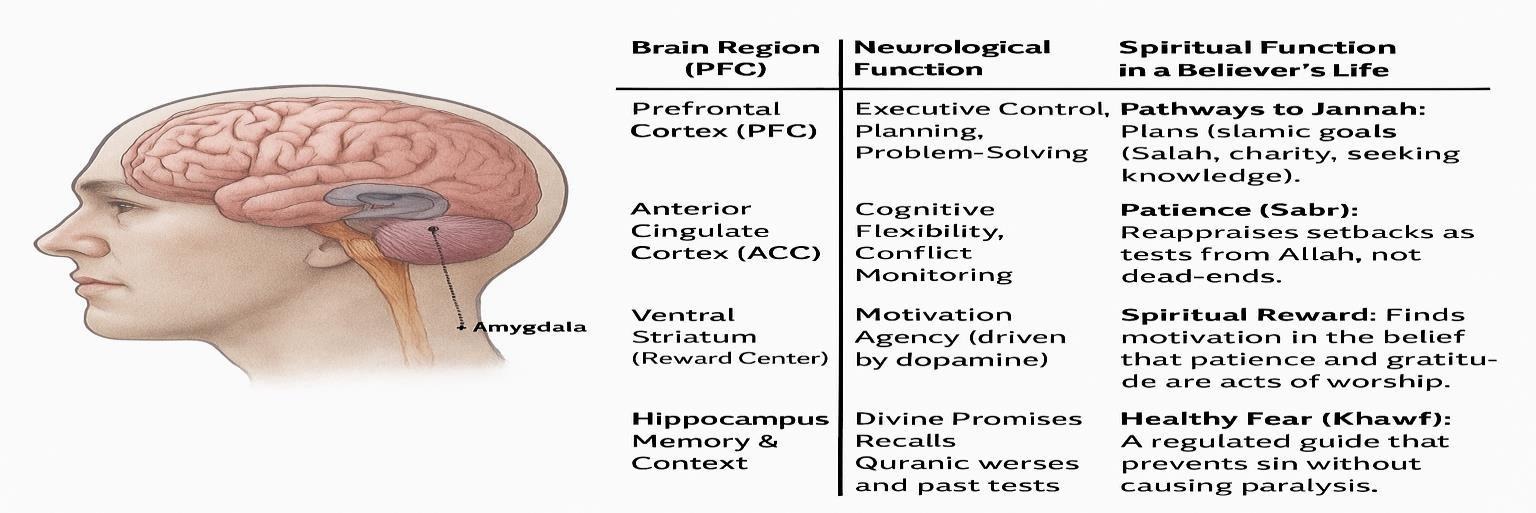
Image Description:
Prefrontal Cortex: Located at the front of the brain, just behind the forehead — responsible for thinking and planning. Regulates emotions by controlling the amygdala, helping reduce fear and enabling rational thinking. Moreover it supports sabr through self-control and long-term focus, nurturing hope during hardship by balancing emotions and goals, the PFC helps us face fear calmly and remain hopeful with patience.
Anterior Cingulate Cortex: Sits just above the corpus callosum (middle top), helping with conflict resolution and emotional regulation. The ACC detects emotional conflict and signals distress, playing a key role in processing fear and uncertainty. It supports cognitive flexibility, helping us adjust our thoughts and behaviors during difficult times. This balance allows us to manage fear, maintain hope, and practice sabr by staying focused on meaningful goals.
Ventral Striatum: Deep inside the brain, part of the reward circuit, motivating us toward goals. This region processes reward, motivation, and positive anticipation, driving us toward meaningful goals. In the face of fear, it motivates action by reinforcing the value of future relief or success. It supports sabr by linking effort with eventual reward, helping maintain hope through delayed gratification and trust in positive outcomes.
Hippocampus: Curved structure deep in the temporal lobe, critical for memory and learning. The hippocampus stores and retrieves memories, especially those linked to emotional experiences. In fear, it helps recognize patterns of past threats but can also reinforce anxiety if overactive. Through sabr, it supports hope by recalling past resilience and guiding future thinking based on learned endurance and growth.
Amygdala: Almond-shaped clusters near the hippocampus, central to processing fear and emotional reactions. The amygdala processes emotional responses, especially fear and perceived threats, triggering alertness and survival reactions. In fear, it activates instantly, but without regulation, it can lead to anxiety or impulsive reactions. With sabr, the prefrontal cortex helps calm the amygdala, allowing space for hope, reflection, and a more patient, balanced response to hardship.
This hadith warns against extremes because they are neurologically and spiritually destructive.
An imbalance directly impacts a child's developing IQ, EQ, and MQ.
The table below contrasts the impacts of balanced hope versus dominant fear:
|
Aspect |
Impact of Balanced Hope & Healthy Fear |
Impact of Dominant Fear (Without Hope) |
|
Mindset & Psychology |
Growth & Agency Mindset: "I can find a way through Allah's mercy." Sees challenges as temporary tests. |
Fixed & Helpless Mindset: "There's no way out." Sees challenges as permanent punishments. |
|
Behavior & Performance |
Approach-Oriented: Proactive in learning, perseveres through difficulties, better academic outcomes. |
Avoidance-Oriented: Procrastination, avoidance of challenges, poorer academic performance. |
|
Emotional Intelligence (EQ) |
High EQ: Better emotional regulation, empathy, and social skills. Manages anxiety and builds strong relationships. |
Low EQ: Difficulty regulating emotions, impulsive reactions, social withdrawal, and higher anxiety. |
|
Spiritual Outlook |
Loving Devotion: Sees Allah as Al-Rahman (The Merciful). Sins out of love to not disappoint the Beloved. |
Despair or Rigidity: May see Allah as primarily punitive, leading to either despair or rigid, fear-based worship. |
Extreme Hope Without Fear:
Brain Impact: Just like an intense focus on a desired reward or hope can suppress the brain’s fear center (amygdala), making negative consequences seem less important. At the same time, the brain’s reward system (mesolimbic dopamine pathway) becomes highly active, driving strong motivation and pleasure-seeking. This overactivation can overpower the prefrontal cortex, reducing self-control, judgment, and moral decisionmaking.
Character Result: Excessive hope without fear can make a person overconfident and feel entitled to reward. It weakens self-discipline, leading to careless decisions and poor control over impulses.
Spiritual Outcome: Is just like too much hope without fear can make a person careless in worship, assuming forgiveness is guaranteed. It leads to taking Allah’s mercy for granted and neglecting sincere effort in faith and obedience.
Extreme Fear Without Hope:
Brain Impact: The brain becomes trapped in a state of high alert, dominated by the amygdala's alarm and stress hormones. This leads to mental paralysis, despair, and an inability to plan for the future.
Character Result: Pervasive fear without hope cripples the will to act, trapping the individual in a state of constant anxiety. This inevitably deepens into despair and the conviction of learned helplessness.
Spiritual Outcome: Extreme fear without hope can distort one’s view of Allah, seeing Him only as harsh or punishing. This mindset replaces love and trust with anxiety and despair. It can lead to spiritual burnout, loss of motivation, and withdrawal from loving Allah and acts of worship.
The life of the Prophet Muhammad (ﷺ) was a perfect embodiment of this neurological balance. He (ﷺ) didn't create uniformity; He (ﷺ) harmonized diversity, showing how different "brain strengths" serve the Humanity.
The Hope of Abu Bakr (RA): His unwavering faith reflects a supremely developed reward, motivation and purposeful action.
The Justice of Umar (RA): The justice of Umar (RA) reflects strong emotional balance guided by deep self-control and moral clarity. His powerful prefrontal regulation allowed reason and faith to govern anger, ensuring fairness in every decision
The Wisdom of Khadijah (RA): The wisdom of Khadijah (RA) reflects exceptional foresight, judgment, and emotional intelligence. Her success in business and calm support of the Prophet ﷺ show advanced planning and decision-making abilities. These qualities point to a highly developed prefrontal cortex, guiding her with clarity, balance, and faith.
The Perseverance of Bilal (RA): The perseverance of Bilal (RA) shows unwavering inner strength and faith-driven self-control. His steadfastness under torture reflects a powerful sense of agency rooted in devotion to Allah alone.
Core Principles from a Balanced Seerah:
Hope through Mercy: The Prophet’s (ﷺ) forgiveness of Mecca teaches youth that no mistakes are final. This belief disengages the stress response (amygdala) and allows the problem-solving PFC to take charge, building resilience and sabr.
Reverent Fear through Accountability: The Prophet (ﷺ) taught profound consciousness of Allah (Taqwa). This isn't a paralyzing fear, but a healthy, guiding fear that regulates the amygdala, helping youth pause and consider consequences.
Wisdom in Application: In every decision, the Prophet (ﷺ) demonstrated how to apply principles with wisdom. This process is a full-brain workout, integrating the PFC (pathways), the reward center, and the amygdala (caution) into a seamless, spirituallyguided track.
We are trying to translate this Prophetic model into contemporary parenting and education here.
For Boosting IQ (Cognitive Intelligence):
Set "Stepping Stone" Goals: Help children break down large tasks. Each success provides a dopamine hit to the reward center, reinforcing their belief in their own center and enhancing learning.
Engage Multiple Intelligences: Move beyond rote learning. Use nature, art and movement to help children develop a blend of intelligences, making them more adaptive problemsolvers .
For Cultivating EQ (Emotional Intelligence):
Emotional Literacy: Actively help children name their emotions ("I see you're feeling frustrated"). This builds self-awareness and strengthens the connection between the emotional limbic system and the rational PFC .
Reframe Failure with Hope: When a child fails a test, avoid shame. Say: "This is a setback, not a failure. Let's look at what went wrong (Pathways). Your effort and patience in difficulty are themselves rewarded by Allah (Agency)." This keeps the PFC engaged and the amygdala calm.
For Fortifying MQ (Moral Quotient):
Service to Others (Networking): Humans are wired for connection. Research shows that helping others increases well-being, reduces stress, and fosters a deep sense of purpose. Encourage children in community service.
Storytelling with Balance:
Stories of Hope: Tell of the Prophet's (ﷺ) hope for the people of Ta'if. This builds strong motivation and reward pathways.
Stories of Reverent Awareness: Tell of the companions who wept upon hearing the Quran. Frame this not as guilt, but as profound love and respect. This trains the amygdala to be a sensitive guide.
The Ultimate "Hope" Activity: Du'a
The Prophet (ﷺ) said, "When one of you calls upon Allah, let him hope for the greatest of things." . Teaching youth to make ambitious du'a is the ultimate exercise for the Hope track, combining pathways (asking), motivation (belief in response), and memory (remembering Allah's promises). This is the very friction, Iqbal might say, that sparks the vitality:
دل سے جو بات نکلتی ہے اثر رکھتی ہے ... پر نہیں طاقت پرواز مگر رکھتی ہے
(The words that come from the heart do carry an impact ... They may not have the power to fly, but they do have the potential.)
This hadith and all details mentioned above of hope and fear is more than spiritual advice. A little effort to create blueprint for building a brain wired for resilience, compassion, and purpose. By grounding our approach in the Seerah, we learn to build unity not by making our children the same, but by helping each one find their unique place in the balanced Ummah. Iqbal poignantly laments the failure to achieve this idea:
حرم پاک بھی اللہ بھی قرآن بھی ايک ... کچھ بڑی بات تھی ہوتے جو مسلمان بھی ايک
(The Holy Sanctuary is one, Allah is one, the Quran is one ... It would have been a great thing if the Muslims too were one.)
Let us strive to nurture a generation whose hearts hold both a hopeful ambition for Jannah by “through a deep love for the Prophet ﷺ” in their heart and a respectful consciousness of Allah's boundaries—a generation whose strength lies in their divinely-inspired unity, not in stifling uniformity.
Let us conclude with Iqbal's powerful call to action, a reminder that the seeds of a magnificent future lie within our youth, waiting for the nourishment of faith and effort to sprout:
نہیں ہے ناامید اقبال اپنی کشت ويراں سے ... ذرا نم ہو تو يہ مٹی بہت زرخیز ہے ساقی
Iqbal is not without hope from his barren garden ... For if it receives just a drop of rain, this soil is most fertile, O Saqi!
May Allah make us among those who balance hope and fear,and grant us success in raising a generation that reflects the beautiful, balanced path of His Prophet ﷺ “through a deep love for Allah and Prophet ﷺ” in their heart. Ameen.